AMD Schola
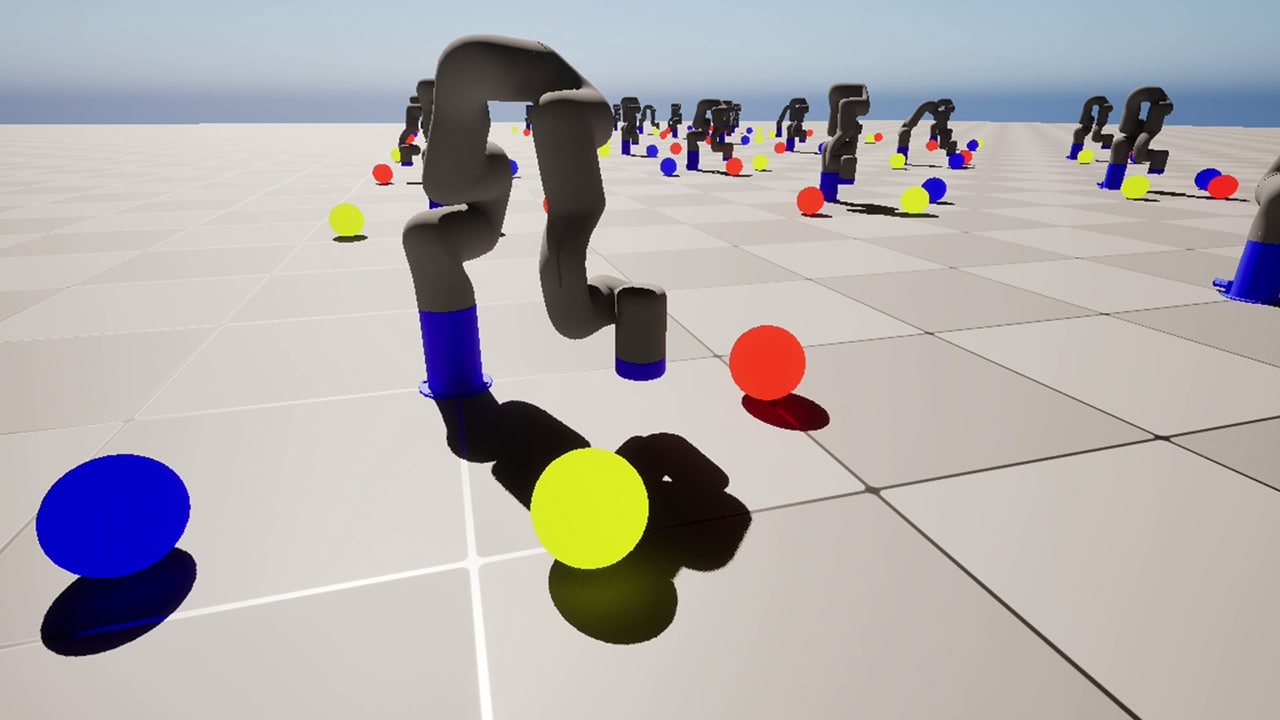
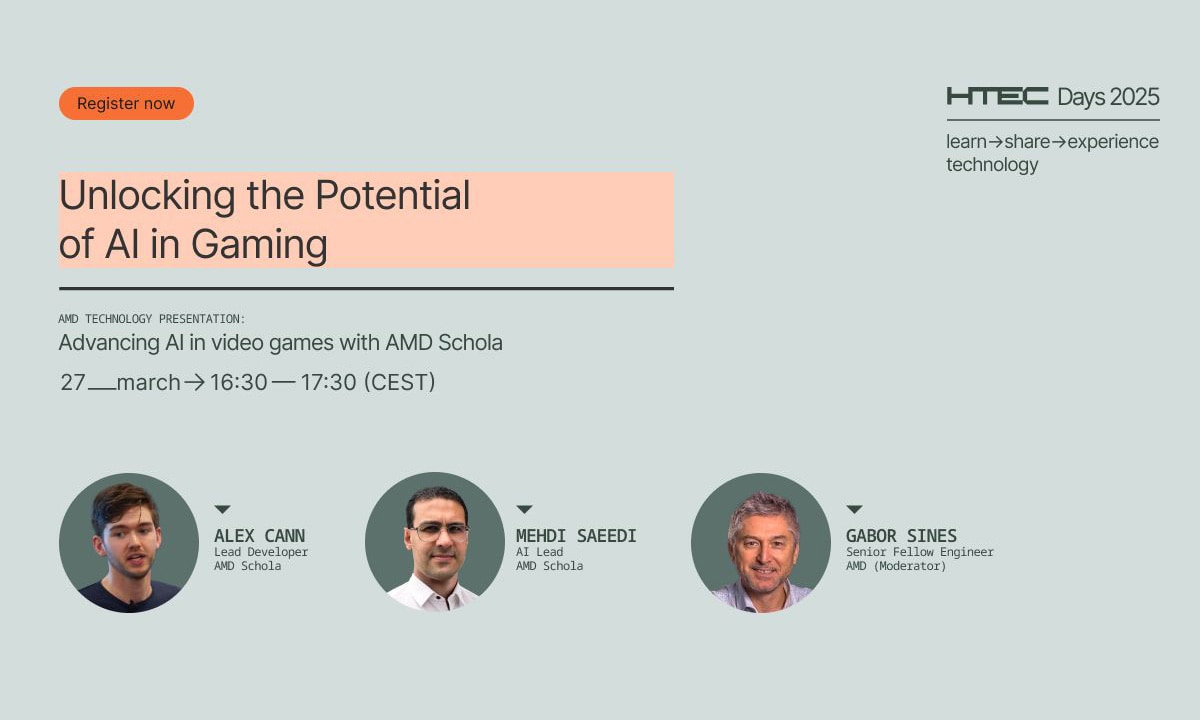
AMD Schola is a library for developing reinforcement learning (RL) agents in Unreal Engine and training with your favorite python-based RL Frameworks.

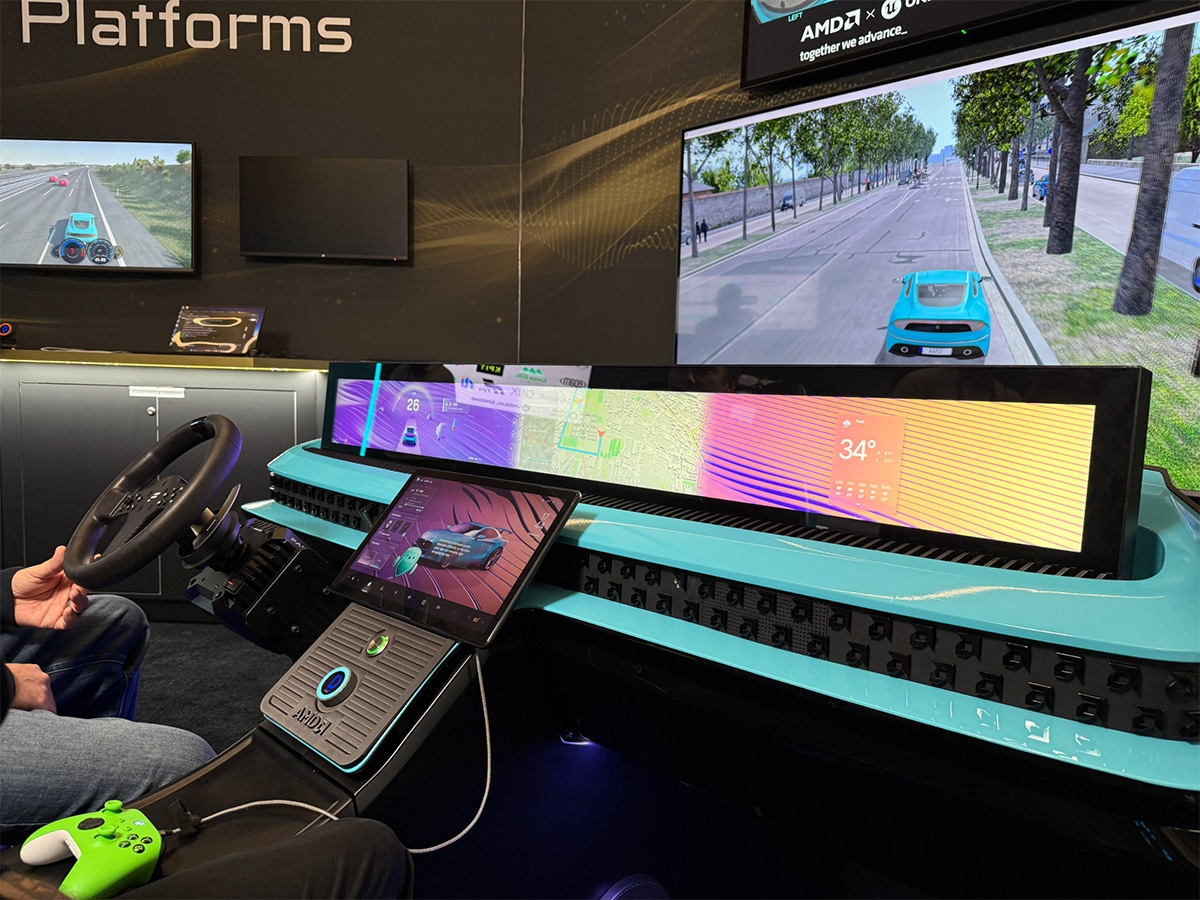
At CES 2026, Epic Games and AMD unveiled the Unreal Engine 5 Next-Gen HMI Experience, powered entirely by the AMD Ryzen™ AI Embedded P100 Series processors. Epic’s new automotive HMI (Human-Machine Interface) showcase allows users to communicate with the vehicle via touchpads and other input systems to preview the future of the digital cockpit. Traditional automotive HMIs are typically assembled from a variety of specialized technologies, each optimized for a specific function but rarely unified. This fragmented approach often results in complexity and limits the ability to optimize the overall user experience.
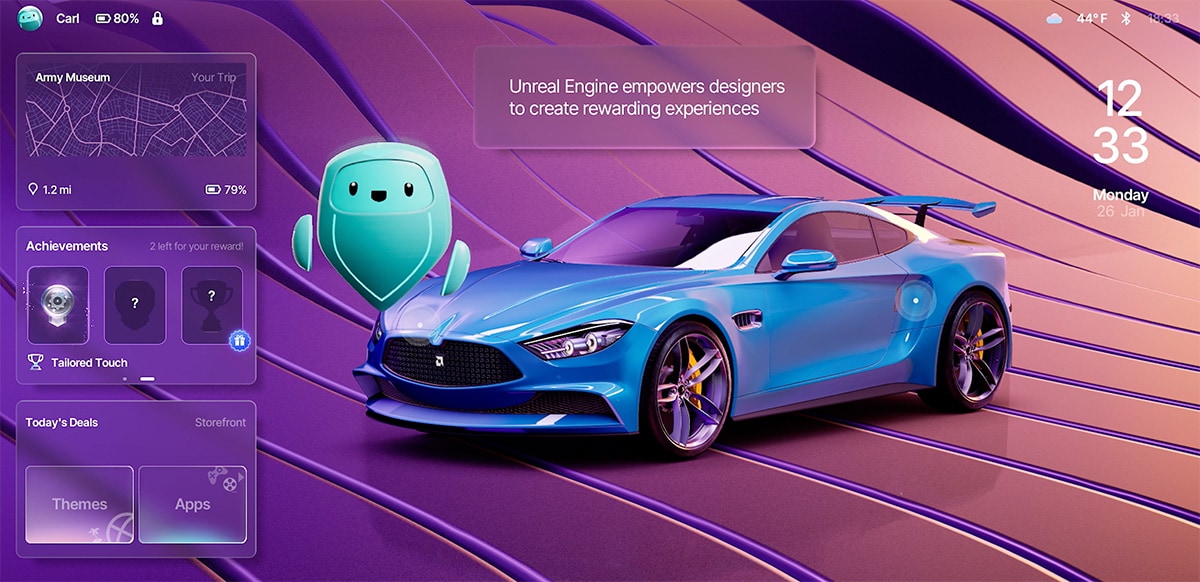
The Unreal Engine 5 Next-Gen HMI Experience changes the status quo by using a single Unreal Engine 5 instance to drive every aspect of the digital cockpit, from instrument clusters and maps to interactive backgrounds and third-party apps. Every element is rendered within Unreal Engine, creating a seamless and unified visual environment. External applications can be integrated smoothly, and developers benefit from advanced tools like Unreal Insights, originally built for AAA games, to profile and tune the entire HMI’s performance on real hardware. This holistic view streamlines optimization and creates a frictionless development experience. Unreal Engine’s Play in Editor (PIE) feature allows developers to preview the full cockpit experience directly on their desktop, accelerating iteration and making development more intuitive.
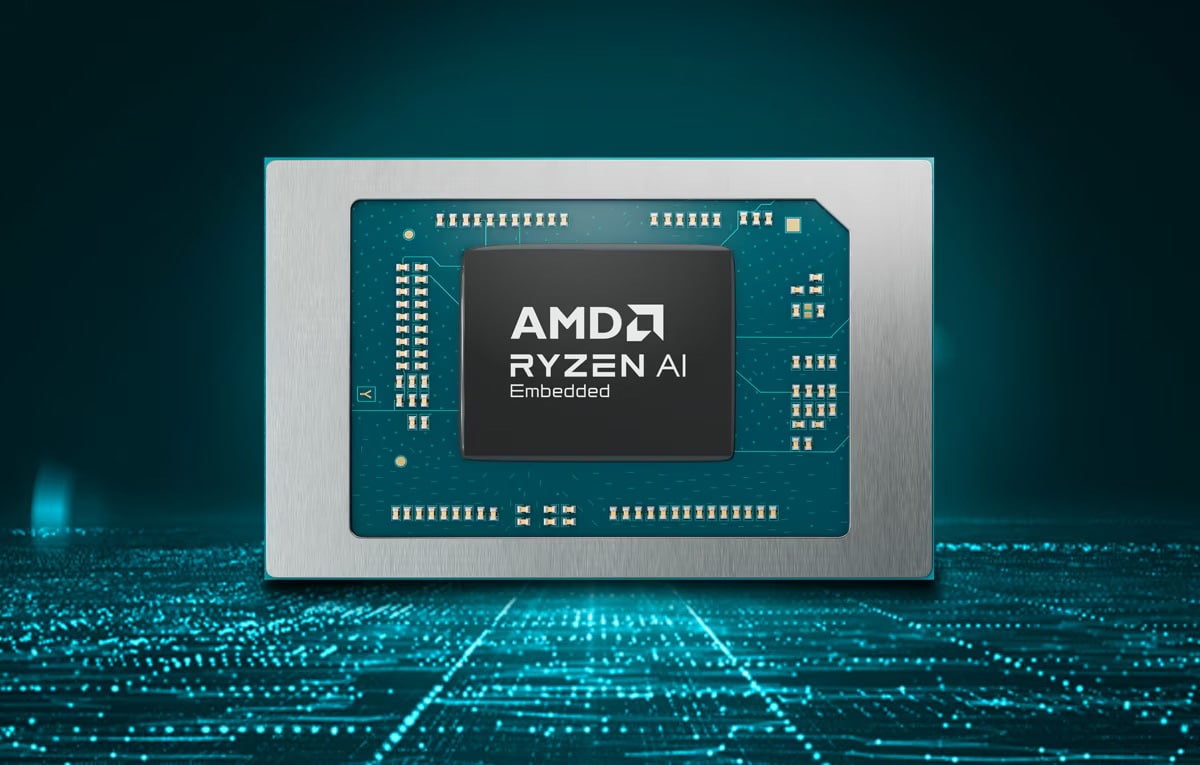
AMD Ryzen AI Embedded P100 Series processors provide the foundation for this next-generation cockpit experience. Ryzen AI Embedded processors deliver a unified software stack spanning CPU, GPU, and NPU, providing a consistent development environment. Developers gain access to optimized CPU libraries, open-standard GPU APIs, and an AI runtime built on AMD XDNA™ architecture through Ryzen AI Software. The stack uses an open-source Xen-based virtualization framework to securely isolate multiple operating system domains. This allows Yocto or Ubuntu to run the HMI, FreeRTOS to handle real-time control, and Android or Windows to support the developer’s needs.
Historically, in-vehicle infotainment (IVI) systems were limited to basic functions, instrument dials, media controls, and isolated entertainment features. These systems operated independently from the advanced driver-assistance systems (ADAS), which handled tasks like cruise control and lane keeping, with little connection to the physical world the vehicle navigates.
As automotive technology moves toward greater autonomy, the need for integration between IVI and ADAS has become clear. Drivers now expect to see what the car’s sensors are seeing, gaining reassurance and a deeper understanding of their environment. Achieving this requires a platform that can connect sensor data, perception algorithms, and high-fidelity visualization — all presented through the HMI.
The Ryzen AI Embedded P100 Series provides the required capabilities. Its unified compute architecture allows for scalable camera inputs, real-time safety subsystems, and high-bandwidth PCIe connections between x86 compute and AMD Versal™ AI Edge Series. This means everything from basic cluster displays to complex ADAS features can be managed within a single, efficient domain controller, reducing cabling and simplifying vehicle architecture.
The integration of AMD RDNA™ 3.5 architecture graphics within AMD Ryzen AI Embedded P100 Series processors brings high-performance gaming-class graphics to the cockpit, enabling high-resolution, high-frame-rate visuals that transform the cabin into an immersive, interactive environment. But the impact goes beyond just hardware.
Epic and AMD have a long history of parallel efforts, from optimizing Unreal Engine for games like Fortnite to virtual production and console experiences. These optimizations and integrations flow directly into automotive HMI, allowing the cockpit to benefit from the very latest in graphics technology delivered at a smooth 60 FPS.
Running a single Unreal Engine 5 instance across the instrument cluster, native maps, minimap, control panel, and 3D backgrounds at 60 FPS started with Epic’s move from embedding Unreal Engine inside individual Android apps to a service-based model. The Android Single Instance Service (ASIS) hosts one engine instance as an Android service and exposes rendering on demand, similar in spirit to the Android camera service but delivering Unreal Engine content instead of a camera feed. This eliminates the overhead of deploying the engine per app and centralizes scheduling, memory, and GPU resource management.
To support developer requirements for multiple concurrent sources of Unreal Engine content across different displays, Epic added MultiWorld to enable distinct cameras to render simultaneously within the same scene, with each view binding to its own “level.” Developers simply assign a level to a display, targeting different portions of the HMI without duplicating worlds. All views share the same underlying RHI (Render Hardware Interface) so common assets, such as the vehicle’s 3D model, reuse graphics state across views, reduce draw overhead and help sustain 60 FPS on high-resolution panels.
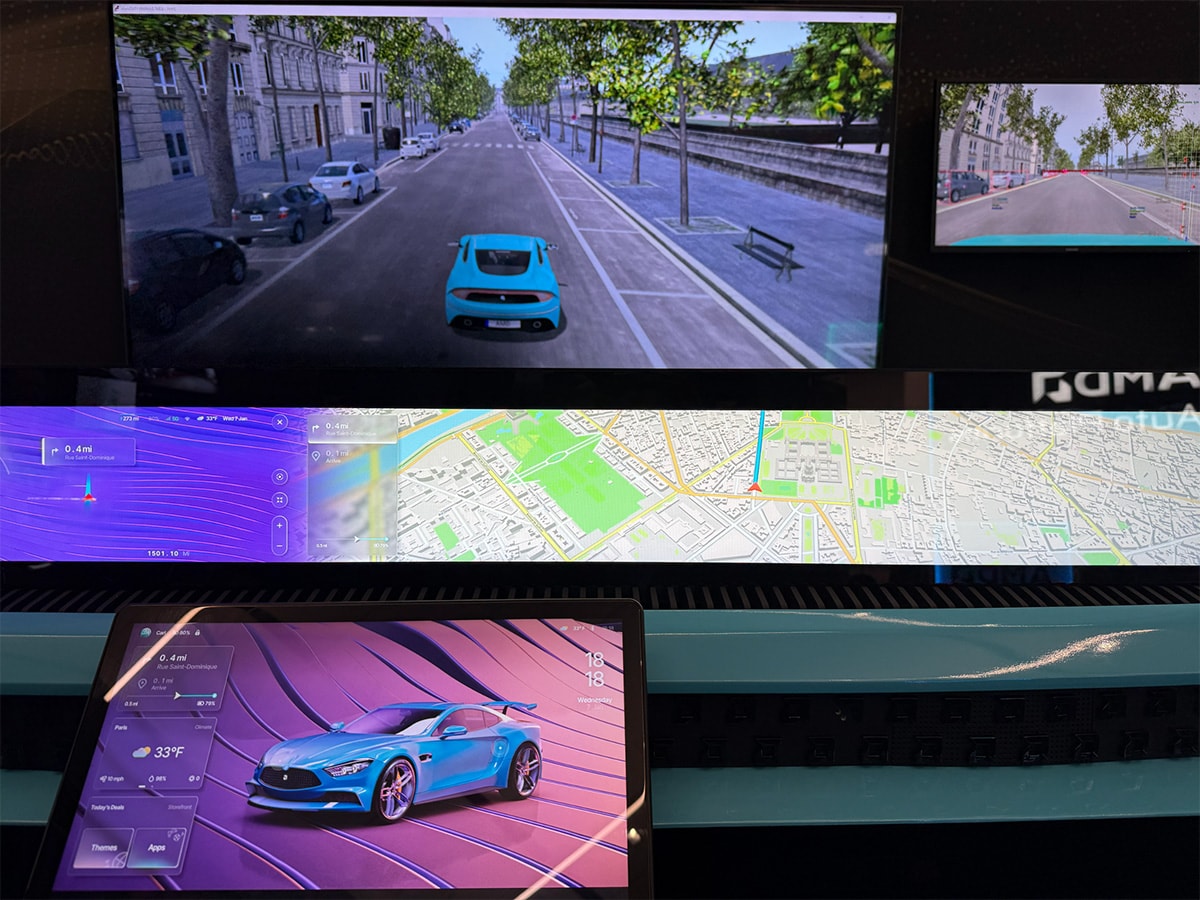
For reliability and safety partitioning, the architecture remains flexible. While a single instance is efficient, developers can isolate critical rendering paths, like running the instrument cluster in one Unreal Engine instance and the rest of the cockpit in another, which means a fault in noncritical content never affects the cluster. This mix-and-match deployment gives integrators a practical toolbox using centralized rendering for performance and profiling, MultiWorld with per-view levels for content routing, and optional instance isolation for functional safety. Together with AMD’s graphics pipeline and driver optimizations, this design is what makes a unified, multi-display, 60 FPS digital cockpit feasible without resorting to a patchwork of disparate renderers.
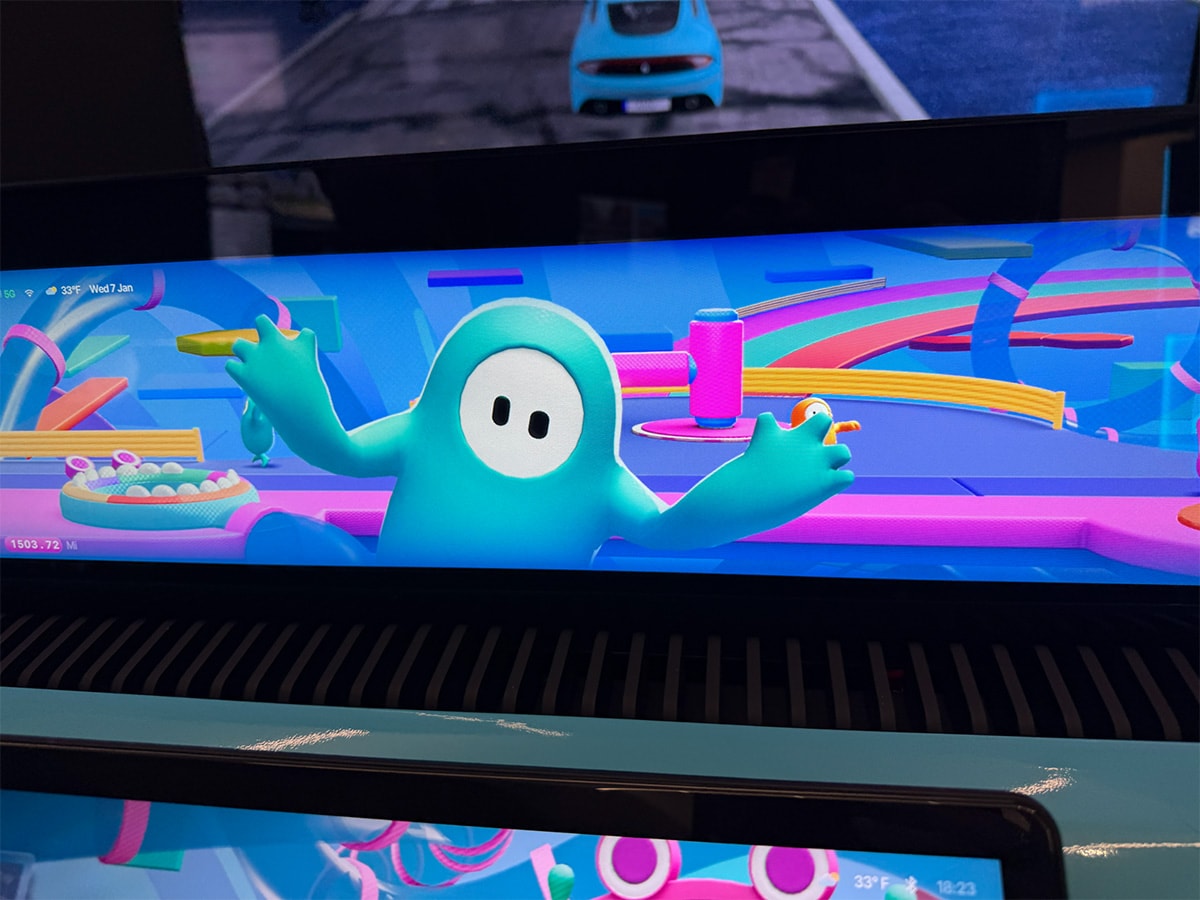
The Unreal Engine 5 Next-Gen HMI Experience fully takes advantage of the hardware it’s running on. Users can enjoy customizable visuals and interactive themes, including playful experiences like Fall Guys with controllable Beans, bringing game mechanics directly into the HMI. Navigation is elevated with native maps that offer both 2D aerial views and immersive 3D street-level navigation, complete with points of interest and iconic landmarks. The versatility of AMD RDNA 3.5 architecture graphics means drivers and passengers can launch third-party applications, from games to audio and video streaming platforms, right from the cockpit. And for those who want to take a break or entertain passengers, the system even allows for playing games like Rocket League within the digital cockpit itself.
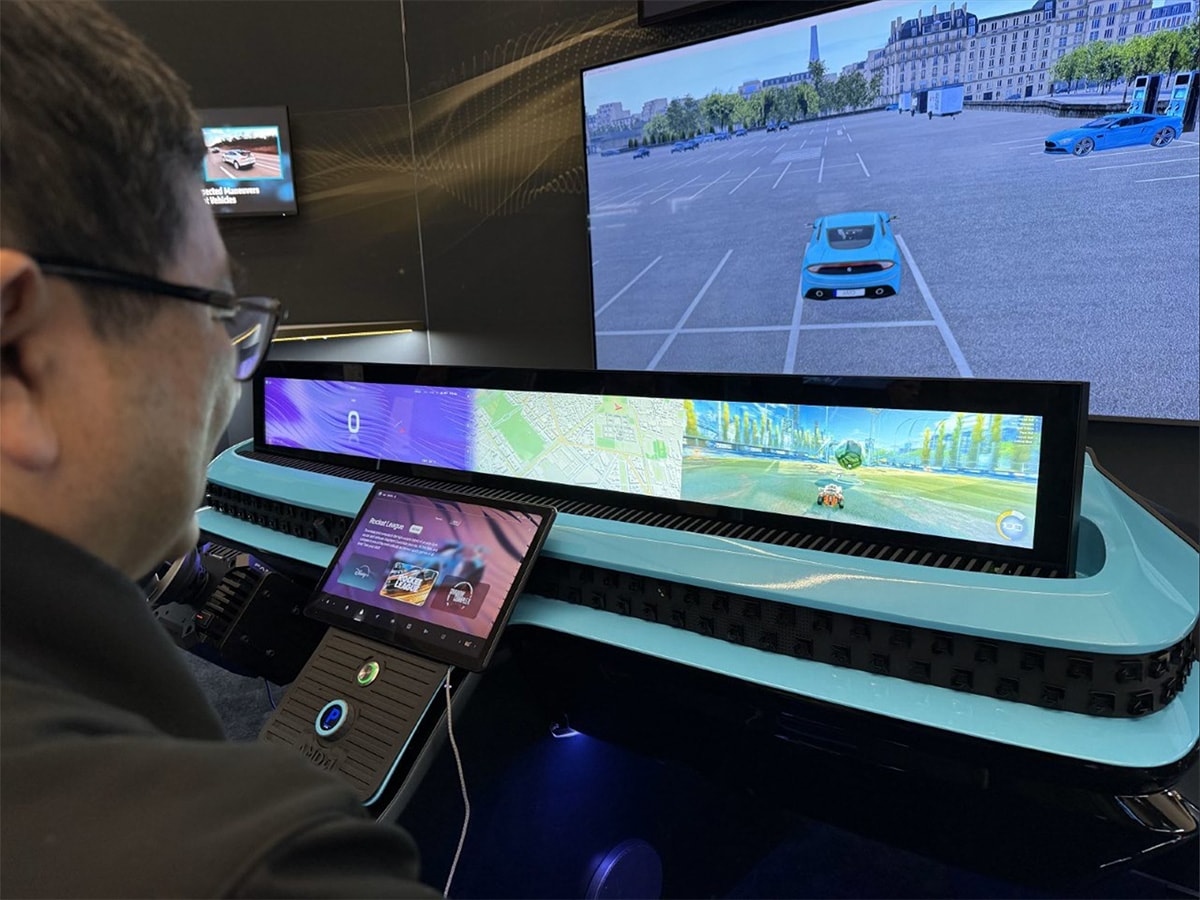
The Unreal Engine 5 Next-Gen HMI Experience running on AMD Ryzen AI Embedded P100 Series processors is more than just a technical demo, it’s a vision for what’s next in automotive technology. By unifying high-performance compute, advanced graphics, and seamless integration between IVI and ADAS, this platform shows off a new standard for what’s possible inside the vehicle. For developers, the streamlined workflow and powerful toolset mean faster innovation and the ability to deliver richer, more interactive experiences. For drivers and passengers, it promises a cockpit that’s not only visually stunning but also more connected, customizable, and entertaining than ever before.
As the automotive industry moves toward greater autonomy and smarter vehicles, the collaboration between Epic Games and AMD is paving the way for a new era of in-cabin experiences. The CES demo is just the beginning. Expect further advancements as these technologies continue to evolve and redefine what it means to be behind the wheel. Stay tuned for more developments as Epic and AMD continue to push the boundaries of automotive technology.
Learn more about the Automotive Grade AMD Ryzen AI Embedded P122a, P132a, and other Ryzen AI Embedded P100 Series processors here.
Read the Epic Games “Unreal Engine is everywhere at CES 2026 — from HMIs to simulation and beyond” blog.
Discuss this blog on the AMD Developer Community.
Sign up to our AMD Developer Newsletter for the latest updates.
Unreal® is a trademark or registered trademark of Epic Games, Inc. in the United States of America and elsewhere.
Links to third party sites are provided for convenience and unless explicitly stated, AMD is not responsible for the contents of such linked sites and no endorsement is implied. GD-97.