HIP Ray Tracing
HIP RT is a ray tracing library for HIP, making it easy to write ray tracing applications in HIP.

General Matrix Multiply (GEMM) constitutes a fundamental computational kernel underlying deep learning architectures, notably Multi-Layer Perceptrons (MLPs) and Convolutional Neural Networks (CNNs). This work investigates methodologies for achieving max memory bandwidth utilization for low accuracy GEMMs on AMD RDNA™ 4 architecture graphics cards.
As a compute-bound kernel, GEMM typically demands intensive arithmetic operations; however, optimizing memory bandwidth utilization remains critical for achieving peak performance on modern GPU architectures.
On RDNA 4, global and shared memory load/store instructions operate at uplift to 128-bit (16-byte) width. Can AMD WMMA instructions fully utilize this bandwidth?
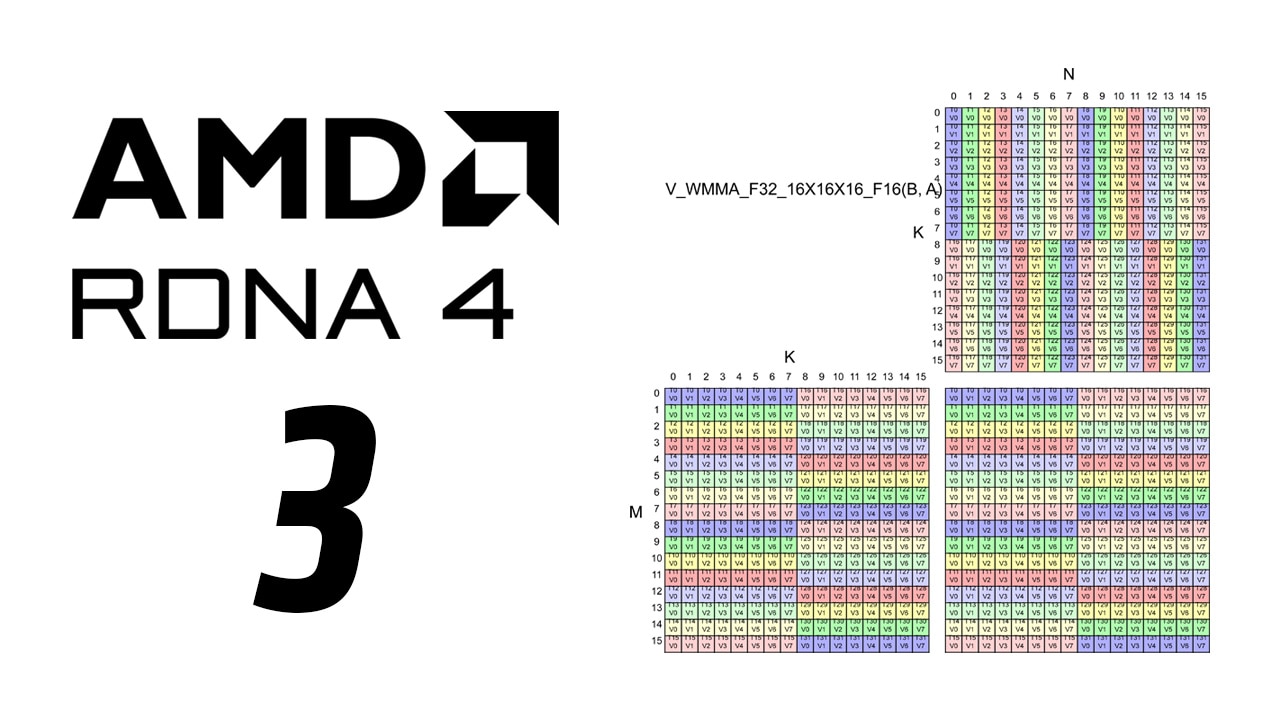
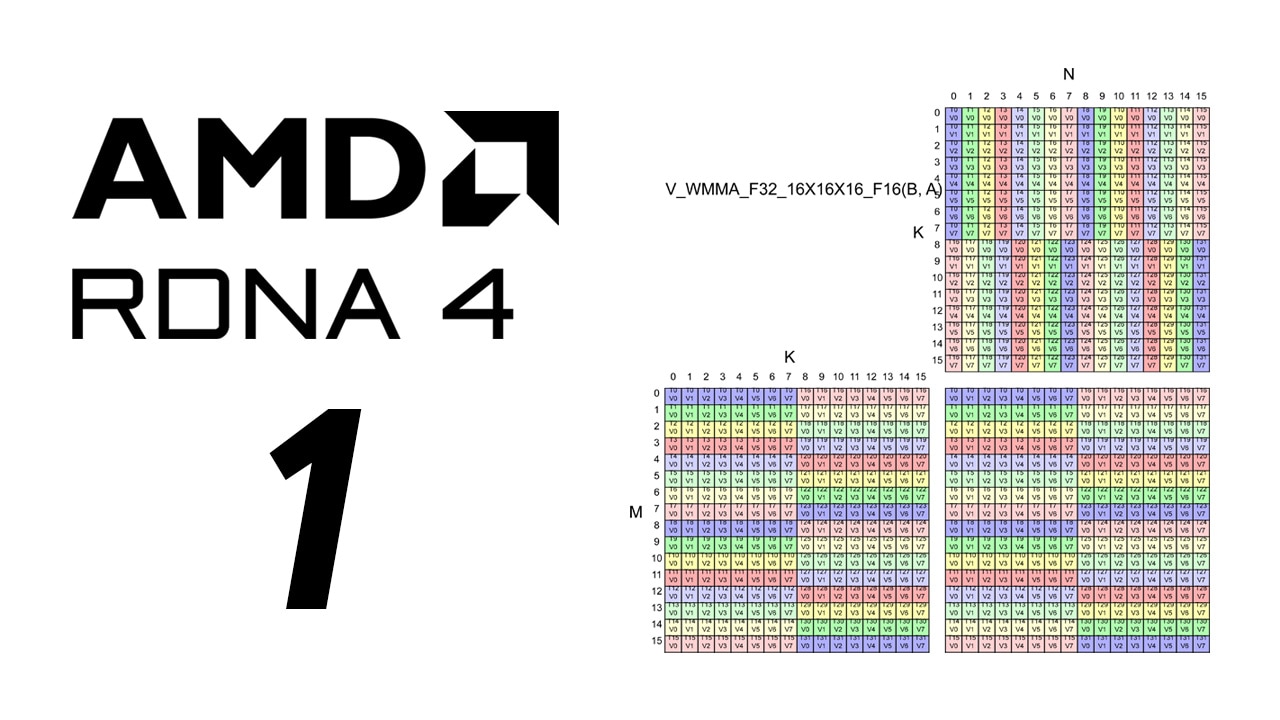
To address this question, we must first understand the WMMA layout on RDNA 4. The article Using the Matrix Cores of AMD RDNA 4 architecture GPUs provides a comprehensive introduction to this topic.
The following illustrates the WMMA layout in RDNA 4. All data types—including FP16, INT8, and INT4—utilize this unified layout:
| Matrix | Position | Dimensions |
|---|---|---|
| A | Lower left | M rows × K columns |
| B | Upper right | K rows × N columns |
| D | Lower right | M rows × N columns |
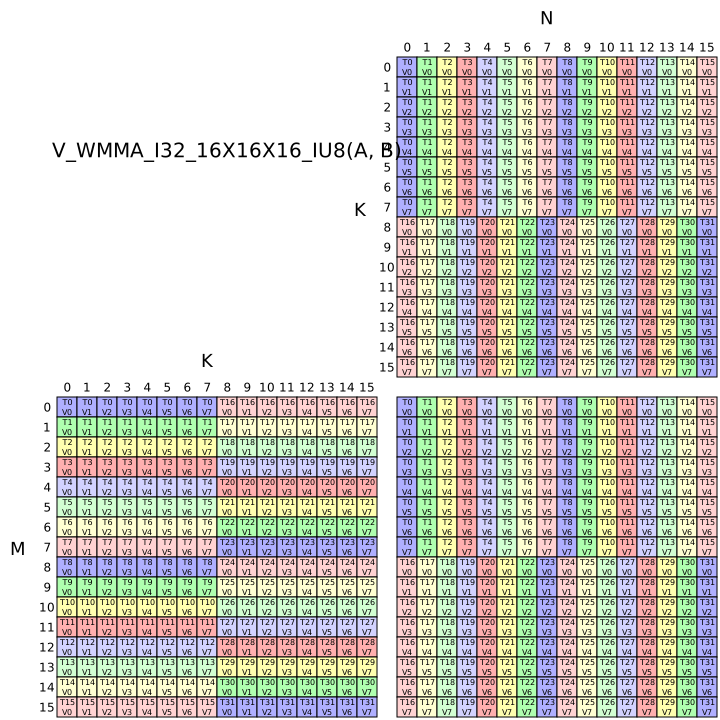
Both matrices A and B are stored in K-major order, with each thread holding 8 contiguous elements. However, the effective vector load width varies by data type: FP16 saturates the 128-bit memory interface (8 × 16 bits), while FP8 and INT8 utilize only 64-bit loads (8 × 8 bits), and INT4 further reduces to 32-bit loads (8 × 4 bits).
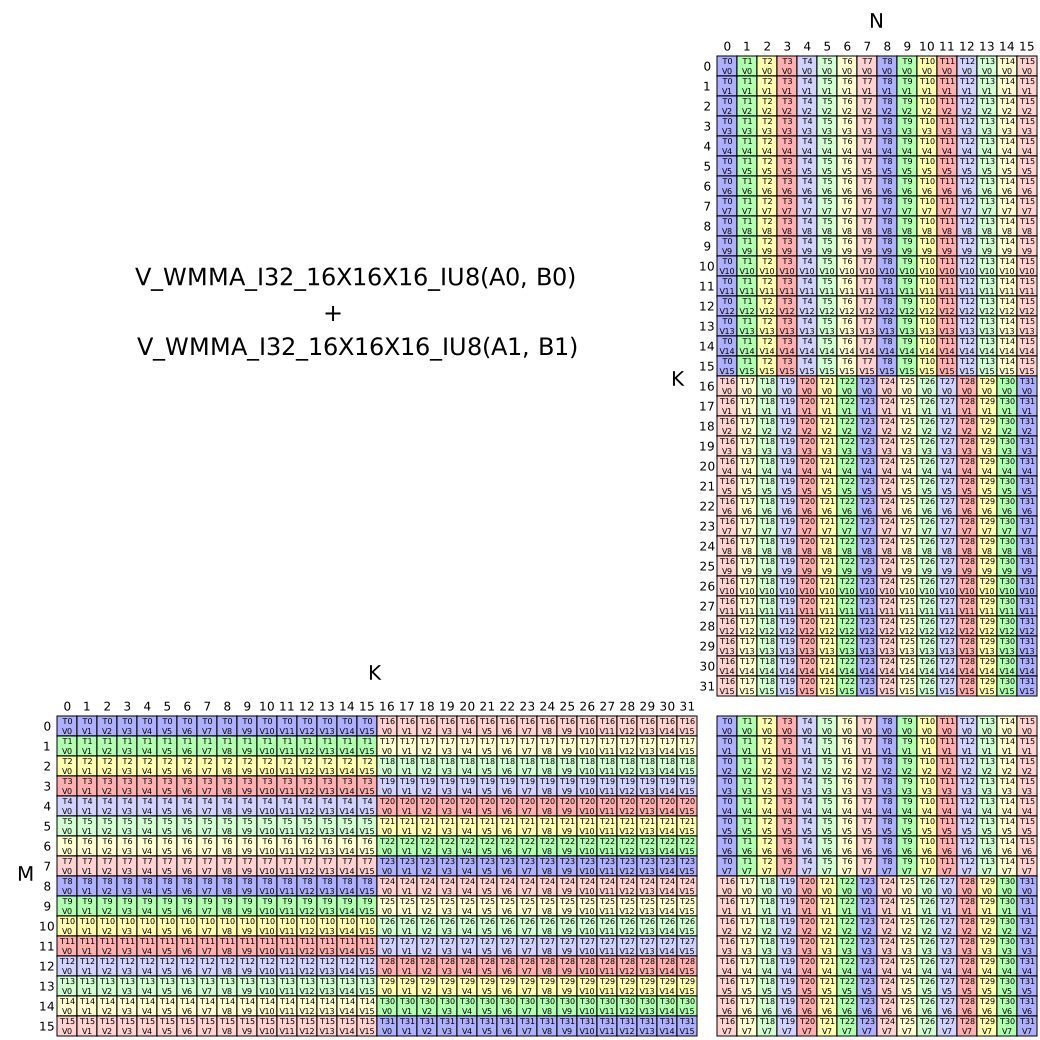
To fully saturate the load bandwidth, one effective strategy is to extend the K dimension of the WMMA operation. Specifically, fusing two WMMA instructions to simulate a double-K WMMA operation for FP8 and INT8 enables the use of 128-bit vector loads in the main loop, effectively doubling memory throughput for these narrower data types.
With the extended K-dimension layout, FP8 and INT8 WMMA operations can now fully saturate the 128-bit memory bandwidth. Each load instruction retrieves 16 elements (128 bits), doubling the data supply rate compared to the native 8-element configuration.
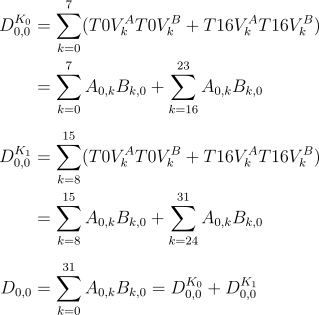
A critical question arises: does extending the K dimension preserve numerical correctness? While this transformation alters the FMA (fused multiply-add) operation order, the result remains bit-identical to regular WMMA due to the associativity of matrix multiplication. We demonstrate this by examining the computation of element D[0][0]:
The following sample code demonstrates the implementation of wide-K WMMA on RDNA 4, along with a validation routine using hipBLAS for numerical correctness verification.
#define HIPBLAS_V2
#include <random>#include <hip/hip_runtime.h>#include <hipblas/hipblas.h>#include <thrust/host_vector.h>#include <thrust/device_vector.h>
constexpr int MMA_M = 16, MMA_N = 16, MMA_K = 32;constexpr int M0_M = 2, M0_N = 3, M0_K = 2;constexpr int WMMA_DATA_WIDTH = 8;
using frag_i8_16 = int8_t __attribute__((ext_vector_type(WMMA_DATA_WIDTH * 2)));using frag_i8_8 = int8_t __attribute__((ext_vector_type(WMMA_DATA_WIDTH)));using frag_i32_8 = int32_t __attribute__((ext_vector_type(WMMA_DATA_WIDTH)));

template <bool signed_a = true, bool signed_b = true, bool signed_c = true>__forceinline__ __device__ void mma_i32i8_16_16_32_gfx12(const frag_i8_16& am, const frag_i8_16& bm, frag_i32_8& cm) {    const int8_t* a_ptr = reinterpret_cast<const int8_t*>(&am);    const int8_t* b_ptr = reinterpret_cast<const int8_t*>(&bm);
    cm = __builtin_amdgcn_wmma_i32_16x16x16_iu8_w32_gfx12(        signed_a, reinterpret_cast<const frag_i8_8&>(a_ptr[0]),        signed_b, reinterpret_cast<const frag_i8_8&>(b_ptr[0]),        cm, signed_c);
    cm = __builtin_amdgcn_wmma_i32_16x16x16_iu8_w32_gfx12(        signed_a, reinterpret_cast<const frag_i8_8&>(a_ptr[WMMA_DATA_WIDTH]),        signed_b, reinterpret_cast<const frag_i8_8&>(b_ptr[WMMA_DATA_WIDTH]),        cm, signed_c);}
__global__ void fused_mma_TN(const int8_t* a, const int8_t* b, int32_t* c) {    constexpr int ab_size = sizeof(frag_i8_16) / sizeof(int8_t);    constexpr int c_size = sizeof(frag_i32_8) / sizeof(int32_t);
    const int lIdx = threadIdx.x;    const int lane = lIdx % ab_size;    const int lane_group = lIdx / ab_size;
    frag_i8_16 a_frag[M0_M][M0_K];    frag_i8_16 b_frag[M0_N][M0_K];    frag_i32_8 c_frag[M0_M][M0_N] = {};
    constexpr int m0_stride_m = MMA_M * M0_K * MMA_K;    constexpr int m0_stride_n = MMA_N * M0_K * MMA_K;    constexpr int m0_stride_k = MMA_K;    constexpr int m0_stride_mma_m = M0_K * MMA_K;    constexpr int m0_stride_mma_n = M0_K * MMA_K;
    for (int m = 0; m < M0_M; ++m) {        for (int k = 0; k < M0_K; ++k) {            int block_idx = m * m0_stride_m + k * m0_stride_k;            int lane_idx = lane * m0_stride_mma_m;            int lane_group_idx = lane_group * ab_size;            a_frag[m][k] = reinterpret_cast<const frag_i8_16&>(a[block_idx + lane_idx + lane_group_idx]);        }    }
    for (int n = 0; n < M0_N; ++n) {        for (int k = 0; k < M0_K; ++k) {            int block_idx = n * m0_stride_n + k * m0_stride_k;            int lane_idx = lane * m0_stride_mma_n;            int lane_group_idx = lane_group * ab_size;            b_frag[n][k] = reinterpret_cast<const frag_i8_16&>(b[block_idx + lane_idx + lane_group_idx]);        }    }
    for (int m = 0; m < M0_M; ++m) {        for (int n = 0; n < M0_N; ++n) {            for (int k = 0; k < M0_K; ++k) {                mma_i32i8_16_16_32_gfx12<true, true, true>(a_frag[m][k], b_frag[n][k], c_frag[m][n]);            }        }    }
    constexpr int c_stride_m = MMA_M;    constexpr int c_stride_n = MMA_N * M0_M * MMA_M;    constexpr int c_stride_mma_n = M0_M * MMA_M;
    for (int n = 0; n < M0_N; ++n) {        for (int m = 0; m < M0_M; ++m) {            int block_idx = m * c_stride_m + n * c_stride_n;            int lane_idx = lane * c_stride_mma_n;            int lane_group_idx = lane_group * c_size;            reinterpret_cast<frag_i32_8&>(c[block_idx + lane_idx + lane_group_idx]) = c_frag[m][n];        }    }}
template <typename T, typename RNG>void gen_rand_data(T* data, size_t n, RNG& rng) {    std::uniform_int_distribution<int32_t> nd(-3, 3);    for (size_t i = 0; i < n; ++i) {        data[i] = static_cast<T>(nd(rng));    }}
int main(int argc, char** argv) {    static_assert(MMA_M == 16, "MMA_M must be 16 for GFX12");    static_assert(MMA_N == 16, "MMA_N must be 16 for GFX12");    static_assert(MMA_K == 32, "MMA_K must be 16 for wide GFX12");    static_assert(WMMA_DATA_WIDTH == 8, "WMMA_DATA_WIDTH must be 8 for GFX12");
    int M0 = M0_M * MMA_M, N0 = M0_N * MMA_N, K0 = M0_K * MMA_K;
    thrust::host_vector<int8_t> h_A(M0 * K0);    thrust::host_vector<int8_t> h_B(N0 * K0);    thrust::host_vector<int32_t> h_C(M0 * N0);
    std::mt19937 rng(2025);    gen_rand_data(h_A.data(), h_A.size(), rng);    gen_rand_data(h_B.data(), h_B.size(), rng);
    thrust::device_vector<int8_t> d_A = h_A;    thrust::device_vector<int8_t> d_B = h_B;    thrust::device_vector<int32_t> d_C = h_C;
    fused_mma_TN<<<dim3(1), dim3(32, 1, 1), 0, 0>>>(d_A.data().get(), d_B.data().get(), d_C.data().get());
    auto err = hipDeviceSynchronize();    printf("err = %d, str = %s\n", err, hipGetErrorString(err));    err = hipGetLastError();    printf("err = %d, str = %s\n", err, hipGetErrorString(err));
    h_C = d_C;
    thrust::device_vector<int32_t> d_C_blas(M0 * N0, 0);
    hipblasHandle_t handle;    hipblasCreate(&handle);
    int32_t alpha(1);    int32_t beta(0);
    hipblasStatus_t ret = hipblasGemmEx(        handle, HIPBLAS_OP_T, HIPBLAS_OP_N, M0, N0, K0,        &alpha, d_A.data().get(), HIP_R_8I, K0,        d_B.data().get(), HIP_R_8I, K0, &beta,        d_C_blas.data().get(), HIP_R_32I, M0,        HIPBLAS_COMPUTE_32I, HIPBLAS_GEMM_DEFAULT);
    if (ret == HIPBLAS_STATUS_SUCCESS) {        int diff_num = 0;        thrust::host_vector<int32_t> h_C_blas = d_C_blas;
        for (int i = 0; i < M0 * N0; ++i) {            if (h_C[i] != h_C_blas[i]) {                printf("%i %i\n", h_C[i], h_C_blas[i]);                diff_num++;            }        }
        if (!diff_num) {            printf("Wide MMA has same result as MMA in BLAS GEMM.\n");        }    } else {        printf("hipblas err = %d, str = %s\n", ret, hipblasStatusToString(ret));    }
    hipblasDestroy(handle);
return 0;}Experimental results confirm that the extended-K GEMM implementation on RDNA 4 produces same outputs matching hipBLAS reference. This validates wide-K WMMA as a practical technique for achieving memory-bandwidth-efficient low-precision GEMM on AMD RDNA 4 architecture GPUs.
This technique has also been adopted in Llama.cpp to implement quantized GEMM kernels, extending its applicability to production LLM inference workloads.
Links to third party sites are provided for convenience and unless explicitly stated, AMD is not responsible for the contents of such linked sites and no endorsement is implied. GD-97.