AMD Device Library eXtra (ADLX) SDK
ADLX is a modern library designed to access features and functionality of AMD systems such as Display, 3D graphics, Performance Monitoring, GPU Tuning, and more.


Artificial intelligence (AI) is quickly becoming a new interface for the PC. From intelligent assistants to autonomous agents capable of performing tasks on behalf of users, it’s changing how people interact with software. Yet most AI applications still operate at a relatively high level, lacking direct access to the hardware capabilities that power modern PC experiences.

AMD is helping bridge that gap with the introduction of AMD Device Library eXtra (ADLX) 2.0, enhancing ADLX with a new AI extension framework designed to connect AI applications with AMD graphics technologies through a simple, scalable, and developer-friendly architecture. Built on the foundation of the ADLX SDK, these AI extensions make it easier for developers and partners to create AI-powered experiences that can monitor, manage, and optimize AMD graphics hardware through natural language and intelligent workflows.
For years, ADLX has served as the modern AMD interface for accessing graphics functionality across AMD products. Developers and partners use ADLX to interact with graphics settings, display controls, performance metrics, system monitoring, and GPU tuning capabilities through a streamlined software interface.
The platform has already seen broad adoption across the AMD ecosystem. Today, ADLX powers a variety of partner experiences, including hardware monitoring tools, fan control applications, performance tuning solutions, and integrations for popular graphics technologies such as upscaling, sharpening, and others. ADLX has also enabled OEM experiences, including integration of AMD Video Super Resolution controls within Lenovo Vantage. Building on that success, ADLX 2.0 adds AI extensions that take the next step by enabling AI applications to understand and interact with AMD graphics technologies in meaningful ways. Instead of requiring developers to build custom hardware integration layers, these new ADLX 2.0 extensions provide a pathway between AI systems and GPU controls.
As large language models and AI assistants become increasingly capable, users are beginning to expect interactions that are more complex in nature. They want AI that can take action.
Imagine asking an AI assistant:
With the new ADLX 2.0 capabilities, these types of interactions become significantly easier for developers to implement. The framework enables AI applications to access live GPU telemetry, query graphics capabilities, modify supported settings, and perform tuning operations through structured interfaces designed specifically for AI-driven workflows.
Developers can then focus on creating innovative user experiences while ADLX handles communication with the underlying graphics stack.
At the heart of ADLX 2.0 are two key technologies.
The first is a new set of Python-based ADLX bindings, providing access to ADLX functionality through one of the most widely used programming languages in AI development today. By bringing ADLX capabilities to Python, AMD enables developers to work within familiar AI frameworks and workflows while gaining access to powerful graphics controls.
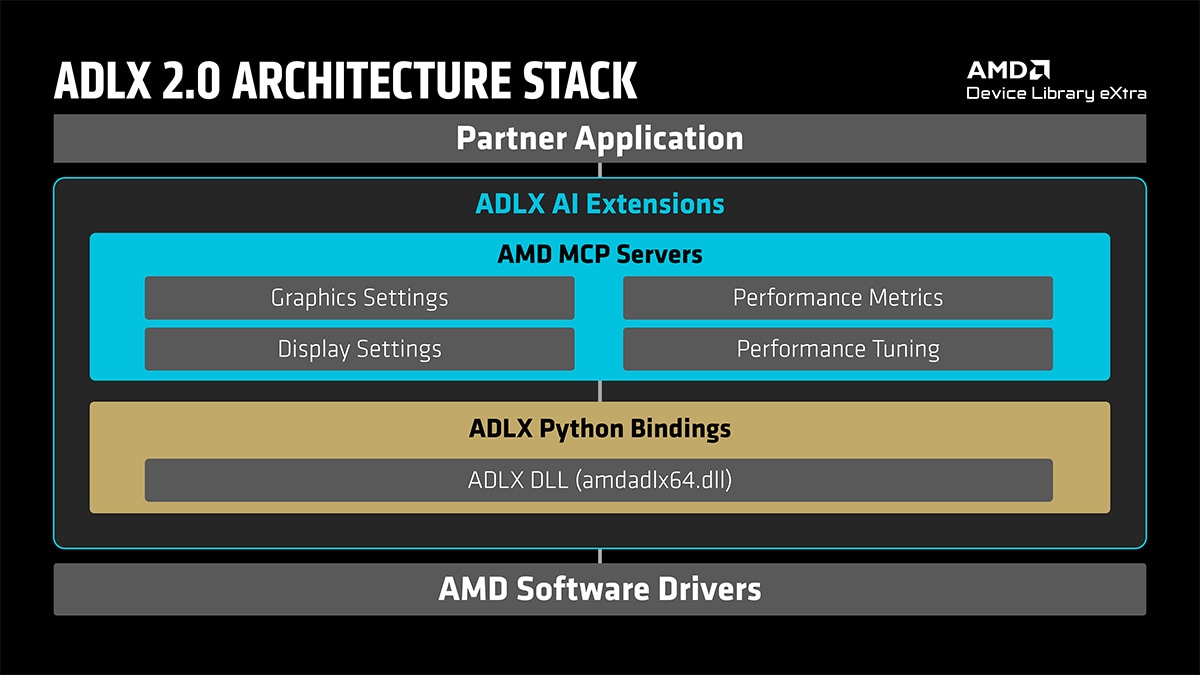
The second is a collection of Model Context Protocol (MCP) servers, which provide structured middleware between AI applications and AMD graphics technologies. MCP has rapidly emerged as a common method for allowing AI agents to discover and interact with external tools and services. Through ADLX MCP servers, AI applications can access graphics settings, display management features, performance monitoring data, and tuning capabilities in a consistent and scalable way.
Together, these technologies create a lightweight AI layer built on top of ADLX, allowing developers to integrate GPU-aware intelligence into their applications with minimal development overhead.
A major goal of ADLX 2.0 is to help partners move quickly from concept to implementation.
To support rapid adoption, AMD is providing a comprehensive package that includes source code, documentation, executable components, examples, and onboarding resources. Developers can install the Python package, review sample implementations, and begin experimenting with AI-powered graphics experiences without needing to build every component from scratch.
This focus on accessibility allows partners to concentrate on what differentiates their products: creating intelligent user experiences that deliver value to customers.
Whether that means building conversational performance dashboards, AI-powered system optimization tools, intelligent recommendation engines, or entirely new categories of applications, ADLX 2.0 provides a flexible foundation upon which developers can innovate.
The initial release of ADLX’s AI Extensions focuses on foundational capabilities, including Python bindings and MCP server infrastructure. Future updates will continue expanding functionality, introducing additional MCP tools, enhancing usability, and incorporating feedback from partners and real-world deployments. Development will also follow an independent release cadence, enabling rapid innovation and faster delivery of new capabilities.
As AI becomes an increasingly important part of the PC experience, the connection between intelligent software and underlying hardware will become more important than ever. ADLX 2.0 represents AMD’s vision for that future: empowering developers to build AI applications that don’t just understand users but can also understand and interact with the AMD technologies powering their systems.
The next generation of intelligent PC experiences is being built today, and with ADLX 2.0, AMD is helping developers bring those experiences to life.
Python is a registered trademark of the PSF.