AMD Radeon™ Memory Visualizer
AMD Radeon™ Memory Visualizer (RMV) is a tool to allow you to gain a deep understanding of how your application uses memory for graphics resources.

Ray tracing is becoming more prevalent in real-time graphics as more GPUs are providing better support for ray tracing and more games are taking advantage of the benefits of ray tracing. A persistent problem that developers are facing is the size and rebuild time for acceleration structures used in large complex scenes. To address some of these issues, AMD is introducing the Ray Tracing Multi-Level Acceleration Structures (RT-MLAS) driver extension as a tool for developers to reduce the size and rebuild time of acceleration structures by adding up to two new levels of reusable acceleration structures in the ray tracing acceleration structure hierarchy. Through complexity encapsulation and acceleration structure reuse, acceleration structures can get smaller and faster to build.
RT-MLAS is available today on AMD Radeon™ RX 9000 Series GPUs and AMD Radeon AI PRO R9700 and R9600 Series GPUs as the provisional Vulkan® extension VK_AMDX_multi_level_acceleration_structure, in the new AMD Software: Adrenalin Edition™ 26.20.25.01 for Expanded Vulkan Extension Support driver. Read the extension specification for full details. We’re planning on adding DirectX® 12 support in the future.
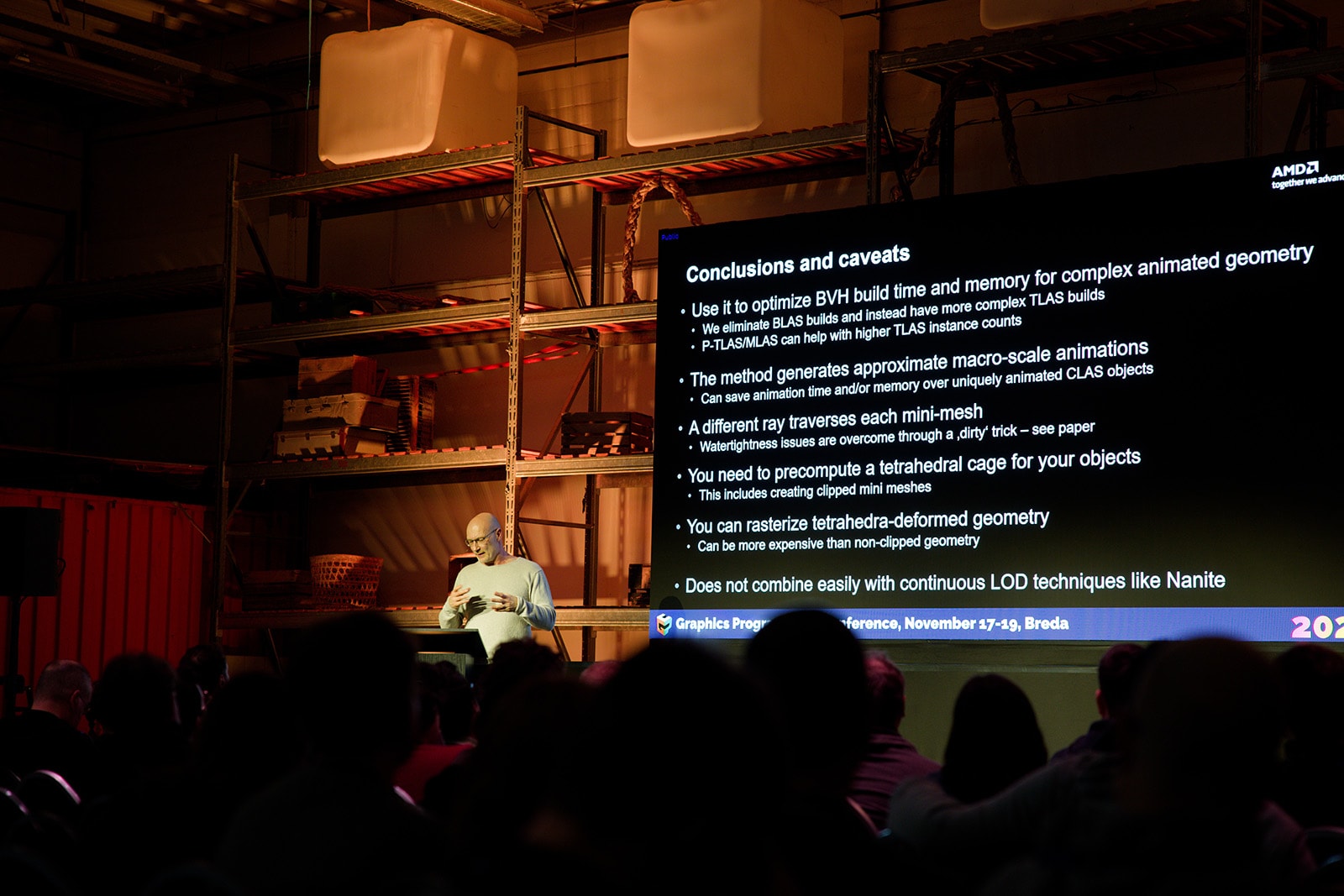
AMD Fellow Holger Gruen also presented RT-MLAS at Graphics Programming Conference 2026, and you can download his presentation (PDF).
RT-MLAS is a new, AMD-exclusive extension to the current ray tracing acceleration structures that introduces the ability to construct Mid-Level Acceleration Structures (MDLAS) and the ability to instantiate these MDLASs inside a top-level acceleration structure (TLAS). MDLAS is a new acceleration structure that contains instances of bottom-level acceleration structures (BLASs) and other MDLASs. The introduction of MDLAS enables developers to add up to two new levels of hierarchy in their ray tracing acceleration structures. An MDLAS is constructed similarly to a TLAS but using the AMD Vulkan® extension VK_AMDX_multi_level_acceleration_structure, and to that extent, the RT-MLAS extension can be viewed as allowing TLAS nesting, but it is not implemented exactly in that manner.
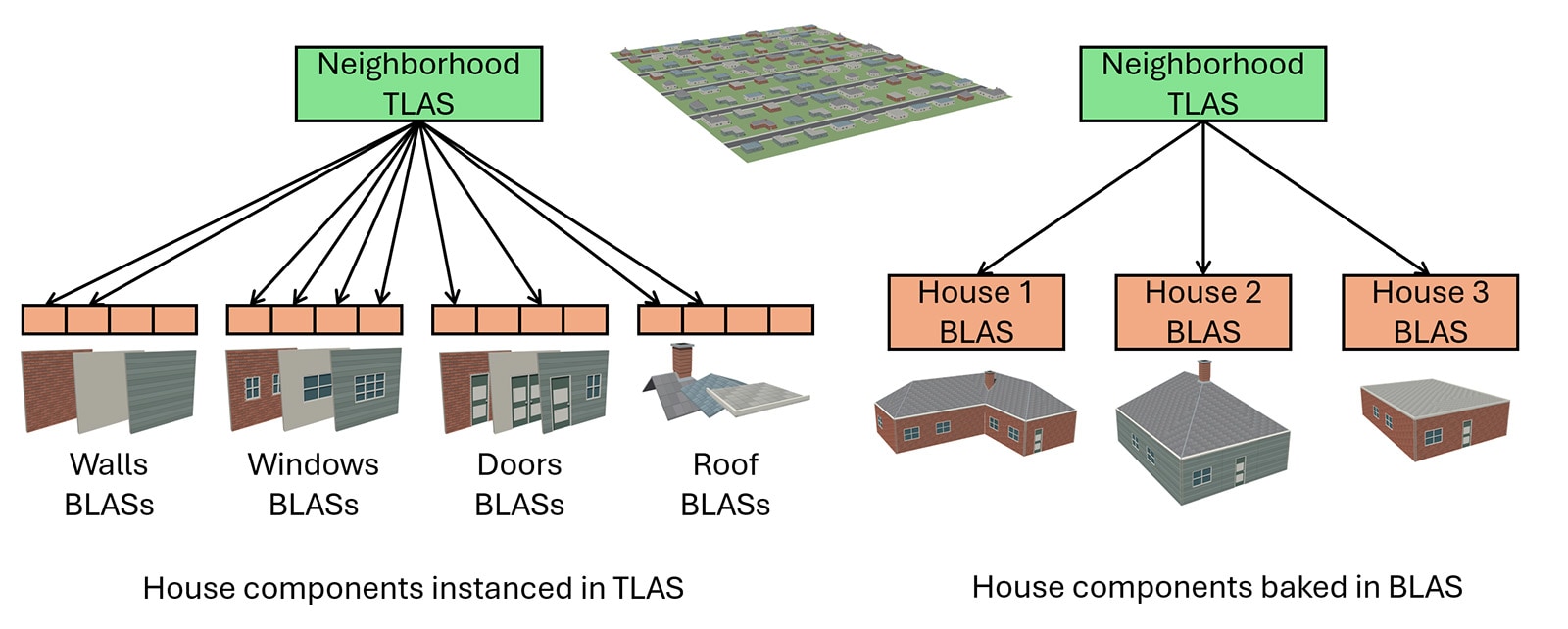
As an example, consider a neighborhood of houses made up of common components: walls, doors, windows and roof pieces. If this neighborhood is ray traced using an acceleration structure made up of just BLAS and TLAS, there are two main options:
The first approach has an efficient usage of BLASs, but the TLAS is massive and it will take a significant amount of time to rebuild. The second approach has an efficient TLAS, but since the BLASs each bake in multiple instances of the components, the BLASs take up a lot of memory. These acceleration structures can be seen in the figure below.
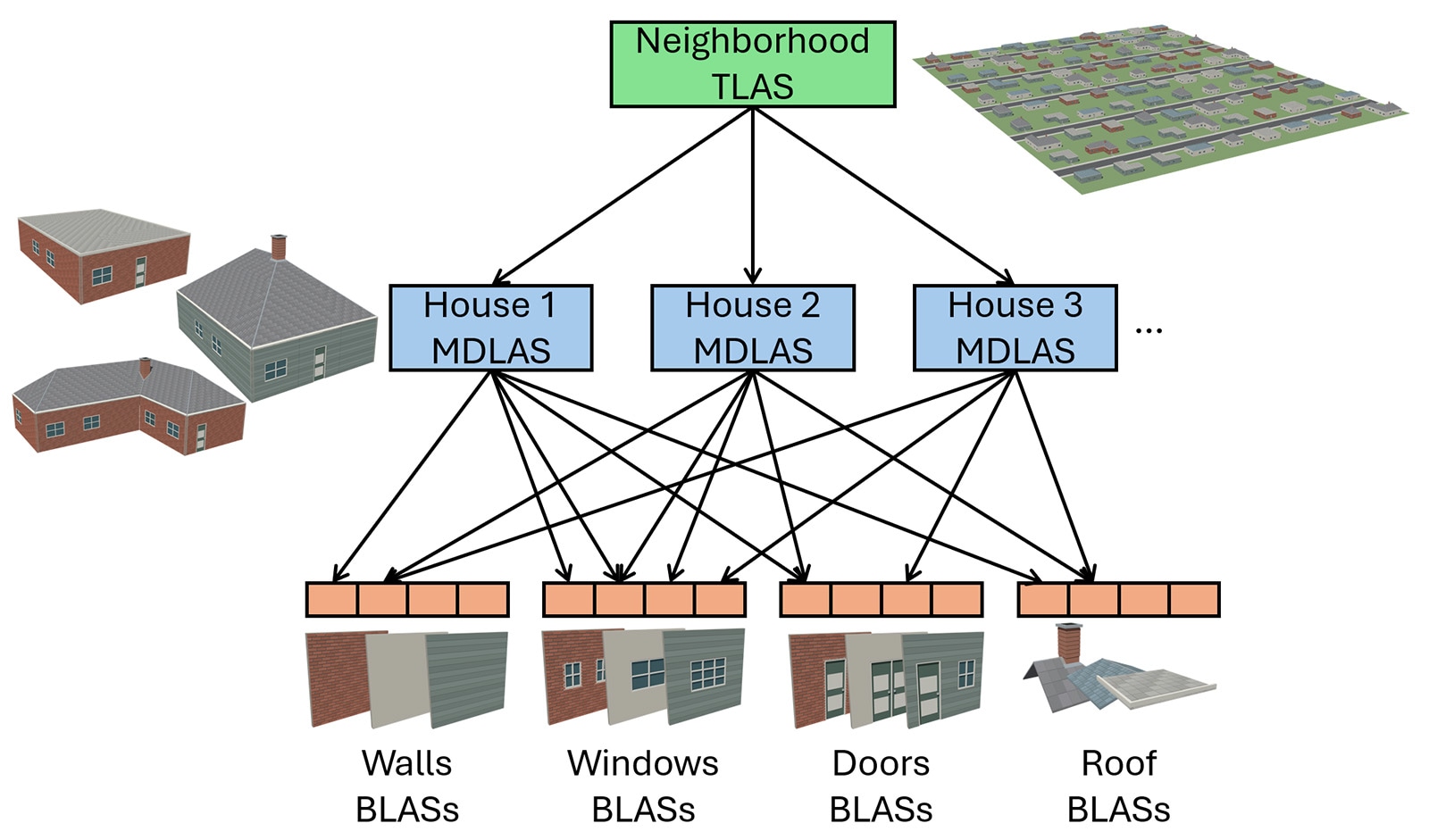
Constructing this neighborhood’s acceleration structure using RT-MLAS gives the developer more options. In this example, you can construct an MDLAS for each unique house that instances the components of the house. Then the TLAS instances the MDLAS of each house in the neighborhood. This approach combines the BLAS efficiency of instantiating components in the TLAS and the TLAS efficiency of constructing BLASs for each unique house. This acceleration structure can be seen in the figure below.
With this driver release, we also released the Acceleration Structure Playground demo app for developers to try out RT-MLAS in Vulkan®. This app lets the user load a complex scene from a glTF™ file and then try out adding MDLASs at different levels of the scene’s hierarchy. Note that this app requires modifications to glTF files beyond the v2.0 standard to provide useful reusable scene hierarchy. Further details can be found in the app’s readme. Using this app requires an AMD Radeon™ RX 9000 Series GPU or AMD Radeon AI PRO R9700 or R9600 Series GPU and the newly released AMD Software: Adrenalin Edition™ 26.20.25.01 for Expanded Vulkan Extension Support driver, which provides VK_AMDX_multi_level_acceleration_structure support.
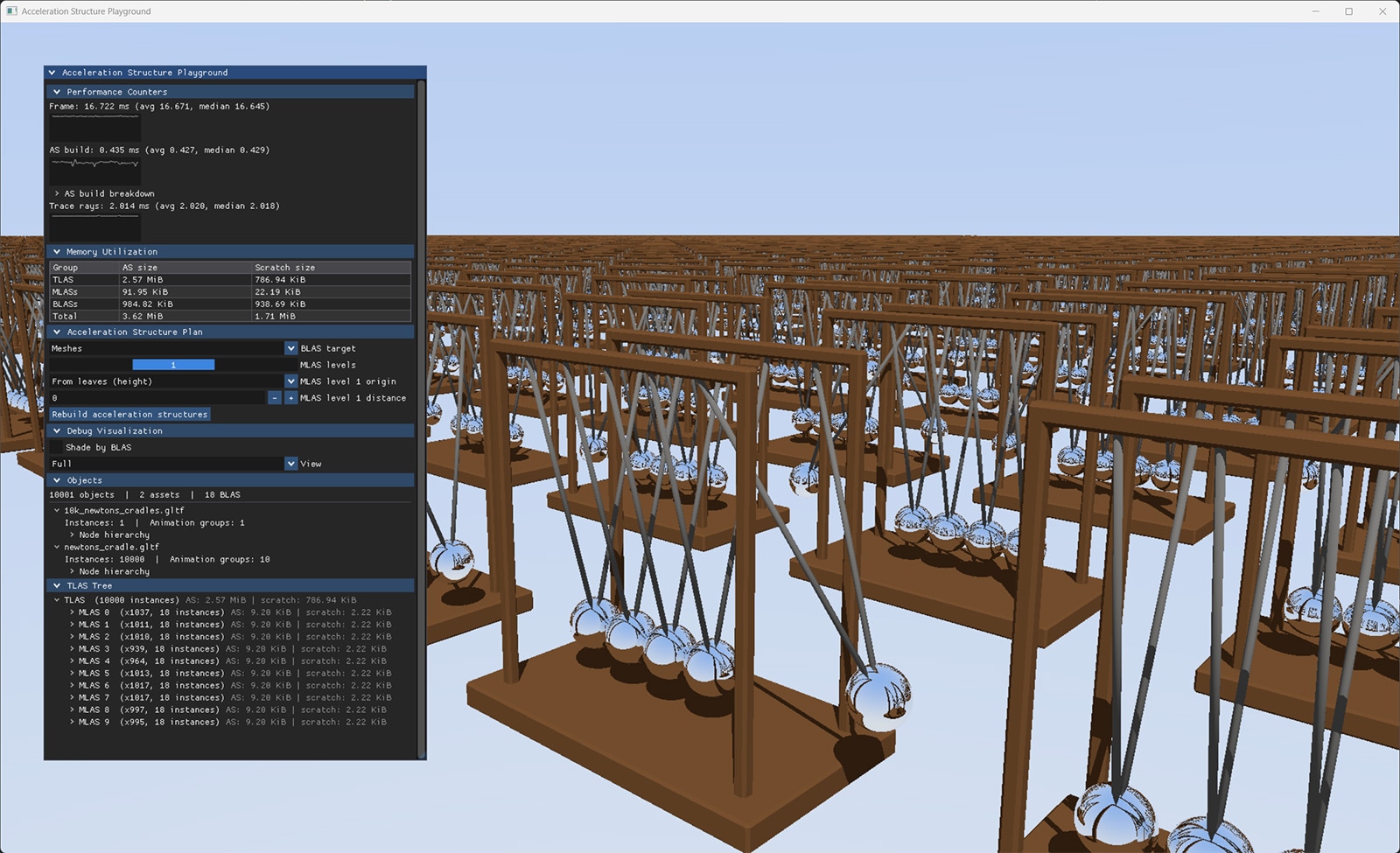
The image above shows a scene of 10,000 Newton’s cradles that are rigidly animated with 10 different animation offsets in use across all the objects. Each component of the Newton’s cradle has its own BLAS, and animated Newton’s cradles are constructed in MDLASs by instantiating the BLAS with the correctly animated transforms. Animations are reused across the scene so only a small number of MDLASs are required. With an AMD Radeon RX 9070 GPU, this scene uses 3.62 MiB of acceleration structures that require 0.43 ms to rebuild. This is a smaller acceleration structure and a faster rebuild time than instantiating the same BLASs directly in the TLAS (BLAS per component) or constructing a BLAS for each uniquely animated Newton’s cradle and rebuilding those BLASs each frame.
| AS Type | Size | Median Rebuild Time |
|---|---|---|
| RT-MLAS | 3.62 MiB | 0.43 ms |
| BLAS per component | 47.17 MiB | 0.97 ms |
| BLAS per unique cradle | 11.55 MiB | 1.60 ms |
Testing by AMD as of November 2026. Test system specs: AMD Ryzen™ 7 5800X CPU, AMD Radeon™ RX 9070 GPU, AMD Software: Adrenalin Edition™ 26.20.25.01 for Expanded Vulkan Extension Support driver, 32 GB RAM, Gigabyte X570 AORUS ELITE WIFI motherboard, Windows® 11 Pro version 10.0.26200.
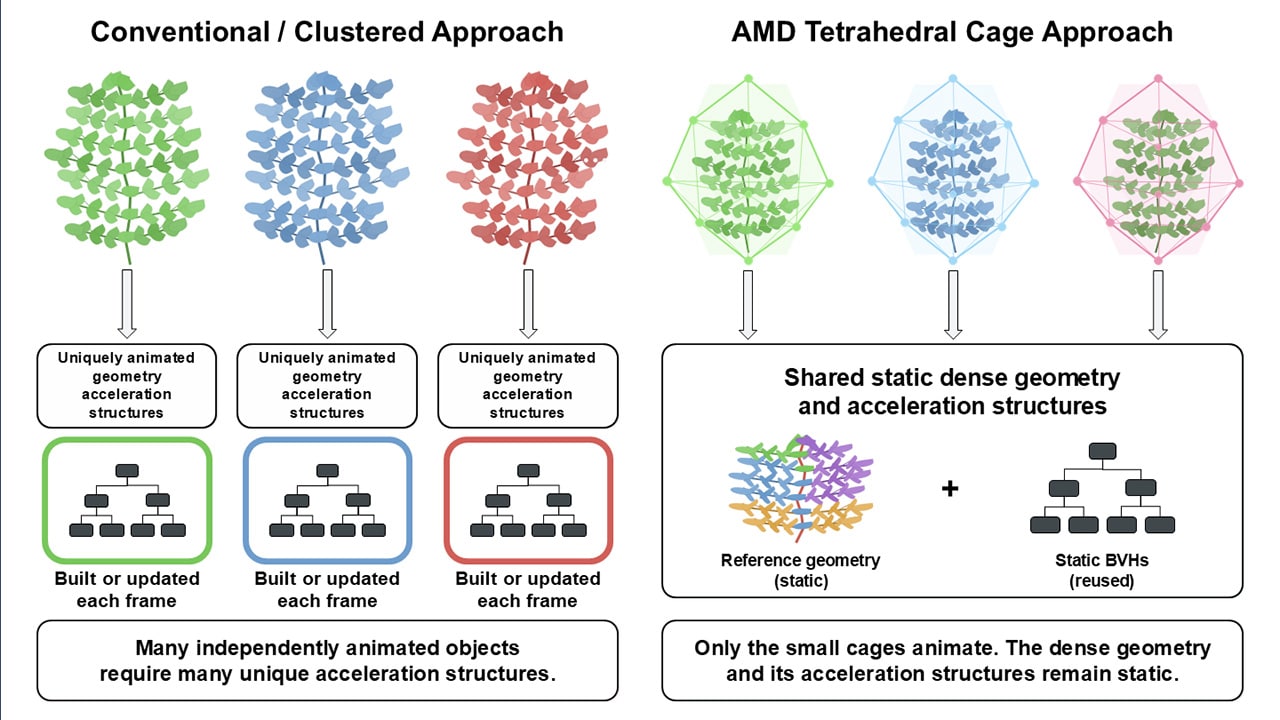
At the moment, there is some ray tracing overhead due to having to track the additional levels of hierarchy in the acceleration structure, so the crossover point for the benefits of RT-MLAS is typically found in scenes that are more complex, like those using tetrahedral cage animation.
Tetrahedral cage animation can significantly reduce acceleration structure size by animating objects using linear transforms on tetrahedral partitions of a rest-pose mesh compared to transforming vertices and rebuilding BLASs. When transforming vertices and rebuilding BLASs, a common way to reduce the animation overhead and bounding volume hierarchy (BVH) size is to reuse animations across objects, for example, having two matching trees swaying in the wind in sync. However, reusing animations cannot further reduce acceleration structure size for these objects, but with RT-MLAS we can see further improvements.
With RT-MLAS, tetrahedral cage animated objects can be separated into their own MDLAS, and each object that is animated in the same way can share an MDLAS. That reuse reduces both acceleration structure size and rebuild time. Furthermore, this improvement can be very significant because it’s possible for tetrahedral cage animated objects to be made up of hundreds to thousands of BLASs, making the difference in acceleration structure size and rebuild time even greater.
To better understand the problems solved by RT-MLAS, let’s look at partitioned top-level acceleration structures (P-TLAS). P-TLAS introduces partitions to the TLAS that can be rebuilt separately. Scenes are often spatially partitioned when using P-TLAS, so motion in one part of the scene can be handled by rebuilding only a few partitions. This reduces acceleration structure rebuild time by reducing the number of objects that need to be considered in the rebuild.
It is possible to use RT-MLAS in a similar manner where each partition is constructed as an MDLAS. In this case, motion in a single partition would require rebuilding the MDLAS of that partition and refitting the much simpler TLAS (the TLAS has one instance per MDLAS instead of having an instance for each object in the scene). Using MDLAS this way instead of P-TLAS involves some trade-offs:
RT-MLAS lets you build repeated and animated parts of a scene once and reuse them wherever they appear, so large, complex scenes need less acceleration structure memory and less time to rebuild. Download the new driver and load a scene into Acceleration Structure Playground on an AMD Radeon™ RX 9000 Series GPU or AMD Radeon AI PRO R9700 or R9600 Series GPU to see where RT-MLAS fits in your Vulkan® renderer. Then tell us what you find on the AMD Developer Community.
VK_AMDX_multi_level_acceleration_structure.Links to third party sites are provided for convenience and unless explicitly stated, AMD is not responsible for the contents of such linked sites and no endorsement is implied. GD-97.
DirectX and Windows are trademarks of the Microsoft group of companies.
Vulkan and the Vulkan logo are registered trademarks of the Khronos Group Inc.
glTF and the glTF logo are trademarks of the Khronos Group Inc.